
Field Education
Internship Success Stories
Kaleb Dunston-Ward (’23)
October 2023
Sean Hatcher (’15)
August 2022



How has your internship led to your current success?
My internship was crucial in setting me up to be where I am today. I always knew that I wanted to make a positive difference in my community by helping others, and my internship was the foundation for me realizing that goal. I decided to accept a paid internship with CRC, a growing company founded by two ECU graduates that specializes in providing background checks for employees that work with vulnerable populations, such as healthcare systems, government entities, and education institutions. During my internship, I learned how to conduct comprehensive background investigations by utilizing various data sources and pulling records from local, state, and federal agencies nationwide. I was able to take what I learned from my classes at ECU and apply it to interpreting criminal record results, which helped me to pick up the company’s processes quicker. Overall, it was a very positive experience; being treated like a full-time employee and having my input heard sealed the deal for me wanting to be a part of this company. Once the internship concluded, I was excited to accept a full time Research Associate role on our Operations team. Over time, the company sponsored my FCRA professional certification as well as my Private Investigator license, and even provided an opportunity for me to build our customer service team from the ground up. Now, after 7 years, I’m overseeing the company’s day-to-day production teams and helping to steer our overall organizational trajectory as CRC’s Operations Manager. Having the opportunity to take what I learned and empower the next generation of leaders within my organization is a dream come true!
What is Field Education?
Field education, also called the internship, is an experiential learning activity that allows students to integrate classroom knowledge with in-field criminal justice practices. A field education course is required for Bachelor of Science in Criminal Justice majors and an elective for Master’s students. Undergraduate students are required to have a satisfactory overall grade point average and enroll in the course during their last semester, in accordance with university catalog provisions. Field education placements must be approved in advance by the departmental program director. Required contact hours are completed in the placement agency. Students are also expected to comply with the other course requirements including attendance at a mandatory orientation meeting.
Advice to future Interns, from Summer 2022 Interns
Field Education Orientation Meeting
Enrollment in the internship is contingent on attending an orientation.
* Orientation meetings will be attended the semester directly before enrollment in the Internship course
| Scheduled Internship Semester (semester you are scheduled to graduate) | Orientation Meeting | Internship Application Due |
|---|---|---|
| Fall 2025 | April 2025 | TBA |
| Spring 2026 | TBA | TBA |
| Fall 2026 | TBA | TBA |
You must attend ONE (1) of the following meeting dates to be considered for a Fall 2025 internship placement:
- Tuesday, April 8th, 2025, 5:00 p.m. Rivers 210 FACE-TO-FACE MEETING
- Monday, April 14th, 2025, 5:00 p.m. Rivers 210 FACE-TO-FACE MEETING
- Wednesday. April 16th, 2025, 5:00 p.m. (A Virtual/Teams link attached) https://teams.microsoft.com/l/meetup-join/19%3ameeting_MjY1YmVkYjAtOWNmYi00MTFiLTk5MmQtOTJiNWYyZGQ5NThj%40thread.v2/0?context=%7b%22Tid%22%3a%2217143cbb-385c-4c45-a36a-c65b72e3eae8%22%2c%22Oid%22%3a%22ef648bd9-9d2e-4b33-9d00-78cef9db31b3%22%7d
- Thursday, April 24th, 2025, 5:00 p.m. (A Virtual/Teams link attached) https://teams.microsoft.com/l/meetup-join/19%3ameeting_ZDdiZDc1ZGEtZDUzNi00YzU0LWI4NTItOTI0YjVhZDYxOGM0%40thread.v2/0?context=%7b%22Tid%22%3a%2217143cbb-385c-4c45-a36a-c65b72e3eae8%22%2c%22Oid%22%3a%22ef648bd9-9d2e-4b33-9d00-78cef9db31b3%22%7d
Benefits of Field Education
Field education is an important component in criminal justice study since many graduates seek employment with agencies or organizations similar to their field placements. The learning experience offers many benefits including the opportunity to 1) bridge course content with practical applications; 2) expose the student to organizational surroundings; 3) make a transition from academic to workplace environs; and 4) facilitate future employment. Field education gives students a chance to improve their job interviewing and occupational socialization skills, hone vocational abilities, and build self confidence in a workplace setting. Moreover, some of our field education students are ultimately employed by the placement agency after graduation. In fact, the National Association of Colleges and Employers (NACE) reports that companies/agencies are more likely to hire people that have interned with their organization, and in a faster time after graduation, than other applicants.
Agency Placement Options
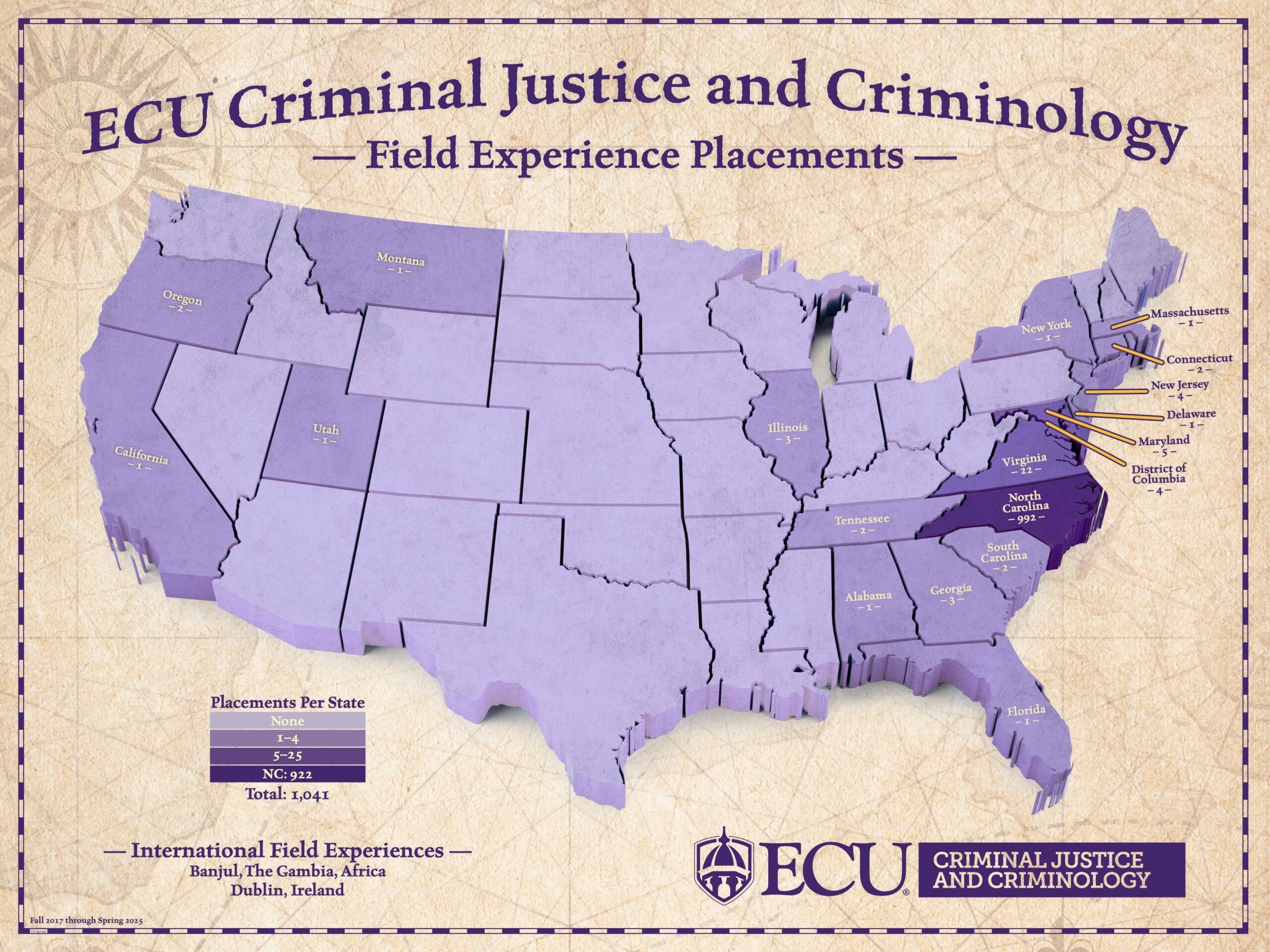
While all placements must be approved, and directly related to the criminal justice field, students arrange their own agency affiliation based upon vocational interest, availability, or locale. The Department has affiliation agreements with a substantial number of agencies and organizations in many criminal justice specializations and geographic areas. For example, our students have been placed in federal, state, and local agencies and non-governmental organizations nationwide. Among these are police departments, courts, prosecutor offices, probation departments, juvenile centers, correctional facilities, victim’s services, and others.
Interns have found placements across the country, and even abroad!
How Much Time is Required?
As a multiple credit hour course, students participating in field education are expected to make a 30-40 hour weekly commitment for the entire semester. The departmental coordinator or course professor will designate the exact number of field hours based on the policy and semester duration. Ordinarily, students are not permitted to be employed or enrolled in on-campus courses during field education because they are fully engaged with the placement agency or organization. Students may only receive credit for the time served in the placement location if it occurs during the semester they are enrolled in the field education course and approved by the departmental coordinator or professor. Agency placement supervisors are expected to make every effort to insure that the student time schedules and assigned duties contribute to a quality learning experience.
For more information, contact Richard Allsbrook, Field Education Director, at:
allsbrookr@ecu.edu or call the main Criminal Justice and Criminology office 252-328-4192.